
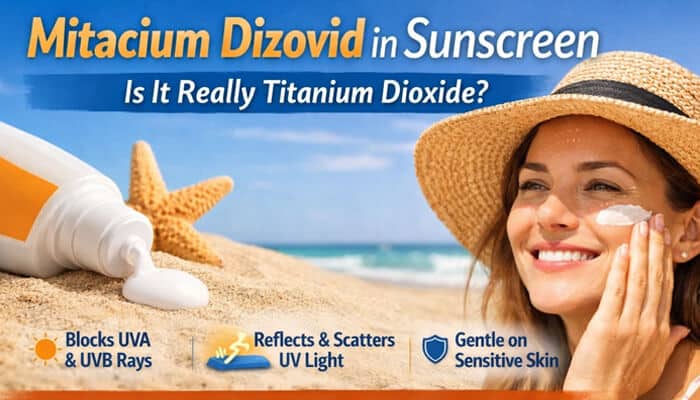

When planning skin protection under the sun, people often read labels on sunscreen bottles and come across complex ingredient names. One such term that many ask about is mitacium dizovid. But what is it? And why mitacium dizovid used in sunscreen?
In truth, there is very limited scientific information available on “mitacium dizovid.” However, many experts believe this is a misinterpretation or mistaken name for a well‑known sunscreen ingredient: titanium dioxide (a mineral used in sunscreens for UV protection). Since there is no verified research or academic reference for “mitacium dizovid,” this article will explain its most likely meaning based on established science and how sunscreen ingredients work.
What Is Mitacium Dizovid?
There’s no recognized scientific definition for mitacium dizovid in dermatology or cosmetic chemistry. Articles mentioning it describe it simply as a compound used for sun protection in sunscreens that helps absorb and reflect UV rays.
Most skincare professionals think this term is incorrectly used in some online articles, and the intended ingredient is titanium dioxide — a proven and widely used mineral in sunscreen formulations.
Understanding How Sunscreens Work
Sunscreens protect your skin by blocking or absorbing harmful ultraviolet (UV) radiation from the sun:
- UVA rays: Penetrate deep into skin and contribute to aging and wrinkles.
- UVB rays: Cause sunburn and can damage DNA.
To block these, sunscreens use:
- Physical (mineral) filters — like titanium dioxide, zinc oxide
- Chemical filters — like avobenzone and others
Why Titanium Dioxide Is Used in Sunscreens
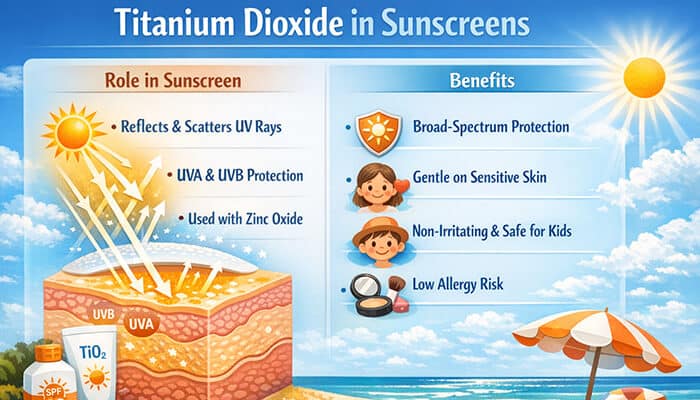
Since mitacium dizovid isn’t a verified compound, let’s look at titanium dioxide (TiO₂), an ingredient that matches the described behavior. Here’s why mitacium dizovid used in sunscreen may actually refer to titanium dioxide:
Role in Sunscreen
- Titanium dioxide forms a protective barrier on the skin’s surface that reflects and scatters UV rays.
- It protects against both UVA and UVB radiation — especially UVB and short UVA waves.
- It’s often used with zinc oxide to create broad‑spectrum sun protection.
Benefits
- Broad‑spectrum protection: Shields skin from multiple UV wavelengths.
- Gentle on skin: Good for sensitive skin because it doesn’t penetrate deeply.
- Non‑irritating: Suitable for children and daily users.
- Broad cosmetic use: Doesn’t usually cause irritation or allergic reactions.
Key Benefits of Using Mineral Filters Like Titanium Dioxide
| Benefit | Why It Matters |
| Broad‑spectrum UV protection | Guards against UVA and UVB rays |
| Physical blocking action | Reflects harmful rays, rather than absorbing them deeply |
| Gentle on skin | Ideal for sensitive or irritated skin |
| Recognized safe | Approved in many countries as a safe sunscreen ingredient |
| Less chemical irritation | Reduced risk of allergy or sensitivity vs some chemical filters |
(Note: Since “mitacium dizovid” isn’t identified in regulatory texts, all benefits here refer to titanium dioxide as the closest equivalent with documented science.)
Misconceptions About Sunscreen Ingredients
There are several myths that go around:
❌ Higher concentration always means better protection.
✔ In reality, too much of certain ingredients can affect texture and feel.
❌ Mineral sunscreens are greasy or chalky.
✔ Modern formulations are often micronized or coated to feel lightweight.
❌ One application lasts all day.
✔ Sunscreen should be reapplied every two hours or after sweating/swimming.
Types of Products That May Contain It
If used, it may appear in:
- Sunscreen lotions
- Cream-based SPF products
- Gel sunscreens
- Spray sunscreens
- Moisturizers with SPF
Is Mitacium Dizovid Safe?
- There is no official dermatological recognition of this ingredient
- It is not listed among approved sunscreen filters in:
- FDA (USA)
- EU cosmetic regulations
- Most information online comes from low-authority or promotional blogs
This suggests:
✔ It may not be a real active UV filter
✔ It could be a branding term or fictional ingredient
Best Sunscreens with Titanium Dioxide
Here are a few highly recommended sunscreens that contain titanium dioxide:
- Neutrogena Sheer Zinc Dry-Touch Sunscreen SPF 50
- EltaMD UV Physical Broad-Spectrum SPF 41
- Blue Lizard Sensitive Mineral Sunscreen SPF 30
These products are known for providing broad-spectrum protection and are formulated for sensitive skin.
Important Warning
If a sunscreen highlights unknown ingredients like Mitacium Dizovid:
Check these before buying:
- SPF rating (at least SPF 30+)
- PA rating (PA+++ or more)
- Ingredient list transparency
- Brand credibility
Some products may act more like a moisturizer than real sun protection.
Conclusion
In sum, the term mitacium dizovid is not recognized in scientific literature, but the concept behind why it would be used in sunscreen is consistent with how titanium dioxide functions — as a mineral UV protector. It reflects and absorbs harmful sun rays, giving your skin defense against sunburn, aging, and UV damage.
If you want effective and gentle sun protection, look for sunscreens that list titanium dioxide (and zinc oxide) on their ingredients label — and don’t forget to reapply every couple of hours for best protection!