
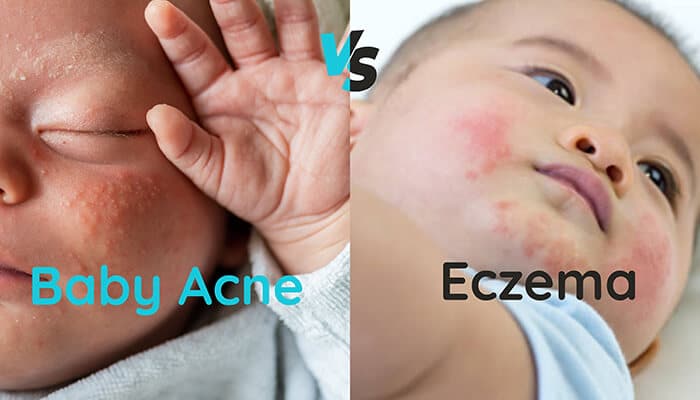

Every parent has been there staring at their baby’s face, heart racing, wondering, “What is that on my baby’s skin?” Tiny red bumps, rough patches, or white spots can appear out of nowhere in the first weeks of life, and it can feel scary when you don’t know what you’re looking at. Baby Acne vs Eczema is a common concern, but the good news is that most of these skin issues are completely normal and very common in newborns and young infants.
When it comes to baby acne vs eczema, these two conditions are often confused because they can look similar on the surface. Both show up as red, irritated skin. Both can appear in the early weeks or months of life. But they are actually very different in terms of what causes them, where they appear on the body, and how you should treat them. Mixing them up can mean doing the wrong thing like moisturizing acne or leaving eczema dry which can make things worse.
This guide is written to give you clear, reliable information so you can tell the difference between baby acne vs eczema with confidence. You will learn exactly what each condition looks like, why it happens, what makes it better or worse, and when you should take your baby to a doctor. No confusing medical language just real, parent-friendly explanations backed by expert knowledge.
What Is Baby Acne?
Baby acne, also known as neonatal acne, is a very common skin condition that affects around 20% of newborns. It shows up as small red or white pimple-like bumps, most often on the cheeks, forehead, nose, and chin.
When Does Baby Acne Appear?
- Baby acne usually shows up within the first 2 to 4 weeks after birth
- It can sometimes appear at birth
- It almost always clears up on its own by 6 to 12 weeks of age
- It rarely lasts beyond 3 months
What Causes Baby Acne?
Baby acne is believed to be caused by maternal hormones that pass from the mother to the baby during pregnancy. These hormones stimulate the baby’s oil glands, leading to clogged pores and small breakouts.
Another type, called infantile acne, can appear between 3 to 6 months of age. This type may be linked to the baby’s own hormones and sometimes requires treatment if it is severe.
Key Signs of Baby Acne
- Small red or white bumps (look like tiny pimples)
- Found mainly on the face cheeks, forehead, nose
- Skin around the bumps looks normal or slightly red
- Baby does NOT seem uncomfortable or itchy
- No dry or flaky skin
- Bumps do NOT spread to the body
- Usually worsens when baby is hot or crying
What Is Baby Eczema?
Baby eczema, medically called atopic dermatitis, is a chronic skin condition that causes dry, itchy, inflamed skin. It is one of the most common skin conditions in children, affecting about 10–20% of infants worldwide.
Unlike baby acne, eczema is not caused by hormones. It is a condition where the skin’s natural protective barrier does not work properly, making the skin lose moisture and become easily irritated by allergens or environmental factors.
When Does Baby Eczema Appear?
- Baby eczema typically first appears between 2 to 6 months of age
- Most children with eczema develop it before age 5
- It can last for years, though many children outgrow it
- It is often a long-term condition with flare-ups and calm periods
What Causes Baby Eczema?
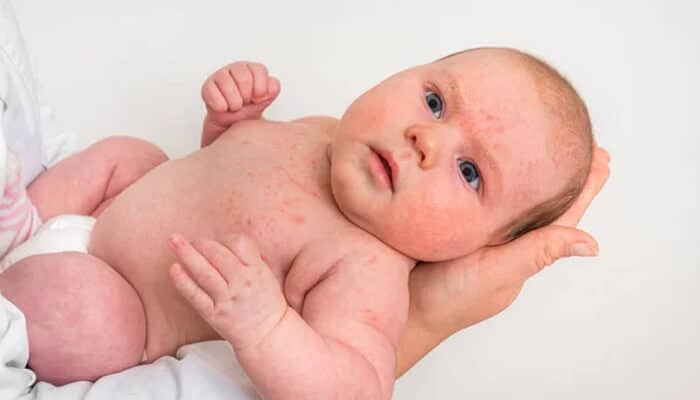
- Genetics: eczema runs in families; if one or both parents have eczema, asthma, or hay fever, the baby is at higher risk
- Skin barrier defect: the outer layer of skin does not hold moisture well
- Immune system response: the skin overreacts to everyday triggers
- Environmental triggers: heat, cold, sweat, certain fabrics, pet dander, smoke
Key Signs of Baby Eczema
- Dry, rough, scaly patches of skin
- Intense itching: babies may rub their face or scratch with their hands
- Redness and inflammation in affected areas
- Skin may ooze, crust, or bleed in severe cases
- Patches appear on the face, scalp, elbows, and behind the knees
- Symptoms get worse during flare-ups
- Skin looks and feels dry even when not in a flare-up
Baby Acne vs Eczema
This table makes it easy to spot the differences at a glance.
| Feature | Baby Acne | Baby Eczema |
| Age of onset | First 2–4 weeks | 2–6 months |
| Appearance | Small red/white pimples | Dry, scaly, rough patches |
| Location | Face (cheeks, nose, forehead) | Face, scalp, elbows, knees |
| Itching | No | Yes, often intense |
| Skin texture | Normal around bumps | Dry and rough |
| Cause | Maternal hormones | Genetics + skin barrier issue |
| Duration | Clears in 6–12 weeks | Can last years |
| Spreads to body | Rarely | Yes |
| Treatment needed | Usually none | Yes, moisturizer + sometimes medication |
| Triggers | Heat, crying | Cold air, allergens, sweat, certain soaps |
| Family history | Not relevant | Often present |
Where Does Each Condition Appear on the Baby’s Body?
One of the easiest ways to tell apart baby acne vs eczema is where the rash or bumps appear.
Baby Acne – Location
- Face only in most cases
- Cheeks are the most common spot
- Also seen on the forehead, chin, and nose
- Occasionally appears on the neck or upper chest
- Almost never spreads to the arms, legs, or back
Baby Eczema – Location
Eczema tends to spread more widely, and the location changes as the baby gets older:
Babies under 6 months:
- Face especially cheeks and forehead
- Scalp
- Outer arms and legs
Babies 6–12 months:
- Begins appearing on the trunk (chest, belly, back)
- Creases of the elbows and behind the knees
- Ankles and wrists
Toddlers:
- Mainly in skin folds elbow creases, behind knees
- Hands and feet
How Each Condition Feels to Your Baby
This is actually one of the most important differences between the two conditions.
Baby Acne – No Discomfort
Baby acne does NOT cause itching or pain. Your baby will not seem bothered by it. They will not rub their face, scratch, or seem uncomfortable because of the bumps. This is a key sign that what you are seeing is acne and not eczema.
Baby Eczema – Itchy and Uncomfortable
Eczema is intensely itchy. Even young babies who cannot scratch with their fingers will rub their face against sheets, clothing, or your shoulder to get relief. Older babies and toddlers will scratch directly at the patches, sometimes making the skin bleed.
Signs your baby is uncomfortable from eczema:
- Rubbing face against surfaces
- Fussiness and irritability, especially at night
- Trouble sleeping because of itching
- Scratching at affected areas
What Does Baby Acne Look Like vs Baby Eczema?
Baby Acne Appearance
Think of baby acne as looking very similar to teenage acne small, individual pimple-like bumps. Each bump is separate. The skin between the bumps usually looks normal. You might see:
- Tiny whiteheads (white dot in the center)
- Small red papules (bumps without a white head)
- Sometimes a little surrounding redness
- Skin looks moist or normal in texture around the bumps
Baby Eczema Appearance
Eczema looks completely different. Instead of individual pimples, you see patches of skin that look:
- Dry and rough: almost sandpaper-like
- Red and inflamed: the whole patch is red, not just individual bumps
- Scaly or flaky: skin may peel or flake off
- Crusted: in bad flare-ups, the skin may ooze and form yellow or golden crusts
- Thickened: over time, repeatedly scratched skin can become thick and leathery
Can a Baby Have Both Acne and Eczema?
Yes, it is possible for a baby to have both conditions at the same time, though it is not very common. A baby might be born with acne in the first weeks and then develop eczema later around 3 to 6 months of age.
If you are seeing bumps on the face that look like pimples AND dry rough patches on the body, it is worth seeing a pediatrician or dermatologist to confirm both diagnoses and get the right treatment plan.
Common Conditions That Look Like Baby Acne or Eczema
Sometimes what looks like baby acne vs eczema is actually something else. Here are other common newborn skin conditions parents mix up:
1. Milia
- Tiny white bumps on the nose and cheeks
- Very common in newborns
- Caused by blocked skin pores, not hormones
- Disappear on their own within a few weeks
- Differ from acne because they have NO redness around them
2. Erythema Toxicum
- Red blotchy rash with yellow or white centers
- Very common in newborns in the first few days
- Looks alarming but is completely harmless
- Goes away without any treatment within 1–2 weeks
3. Cradle Cap (Seborrheic Dermatitis)
- Yellowish, greasy, scaly patches on the scalp
- Can spread to eyebrows and behind the ears
- Often confused with eczema
- Usually not itchy (unlike eczema)
- Clears up on its own or with gentle scalp brushing and baby shampoo
4. Heat Rash (Prickly Heat)
- Small red bumps or blisters
- Appears in skin folds neck, armpits, groin
- Caused by blocked sweat glands in hot weather
- Goes away when the baby cools down
5. Contact Dermatitis
- Red, irritated skin caused by contact with a specific substance
- Could be a new detergent, baby wipe, lotion, or fabric
- Appears where the irritant touched the skin
- Improves when the irritant is removed
Baby Acne Treatment: What Actually Works
The good news about baby acne is that it almost always goes away on its own. Most cases clear up completely within 6 to 12 weeks without any treatment at all.
Do’s for Baby Acne
- Keep the face clean: wash gently with plain warm water once a day
- Pat dry, do not rub: rough rubbing can irritate the skin further
- Be patient: the bumps will go away on their own
- Use breast milk: some parents find dabbing a little breast milk on the bumps helps; while not scientifically proven, it is safe to try
Don’ts for Baby Acne
- Do NOT squeeze or pick the bumps, this can cause infection and scarring
- Do NOT scrub the skin, this makes irritation worse
- Do NOT apply adult acne products, benzoyl peroxide, salicylic acid, retinoids, and other acne products are NOT safe for babies
- Do NOT apply oils or lotions to acne, this can clog pores more and make breakouts worse
- Do NOT try to exfoliate the baby’s skin
When to See a Doctor for Baby Acne
See your pediatrician if:
- The acne is very severe or looks like deep cysts
- The acne lasts longer than 3 months
- You notice pus, swelling, or signs of infection
- Your baby seems to be in pain or discomfort from the bumps
Baby Eczema Treatment: A Step-by-Step Guide
Unlike baby acne, eczema does need treatment to manage symptoms and prevent flare-ups. The goal is to keep the skin hydrated, reduce itching, and avoid triggers.
Step 1 – Moisturize Every Day (Even When Skin Looks Fine)
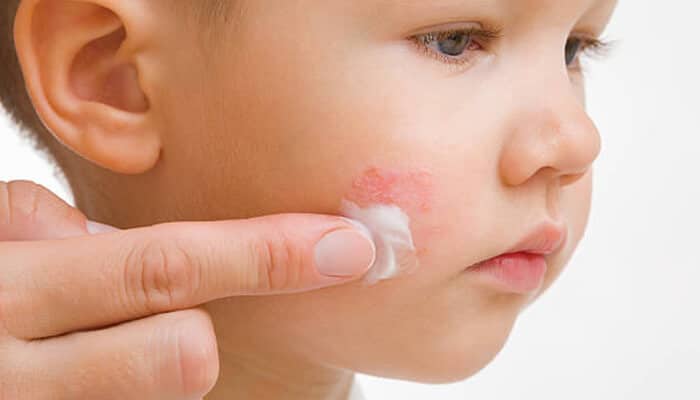
This is the most important step in eczema management. Use a thick, fragrance-free moisturizer or emollient cream twice a day, every single day.
Best types of moisturizers for baby eczema:
- Thick creams or ointments (not thin lotions)
- Fragrance-free and dye-free
- Examples: plain petroleum jelly (Vaseline), CeraVe Baby Cream, Cetaphil Baby, Eucerin Baby
Apply moisturizer within 3 minutes of bathing to lock in moisture, this is called the “soak and seal” method.
Step 2 – Give Short, Lukewarm Baths
- Bath time should be 5–10 minutes maximum
- Use lukewarm water, hot water dries out the skin
- Use a gentle, fragrance-free baby wash, avoid bubble baths
- Pat skin dry gently with a soft towel, never rub
- Apply moisturizer immediately after
Step 3 – Identify and Avoid Triggers
Common eczema triggers to watch out for:
- Fragrances: in soaps, detergents, lotions, or air fresheners
- Harsh fabrics: wool, polyester; stick to soft cotton
- Heat and sweat: overdressing the baby, hot weather
- Pet dander: cat and dog fur
- Dust mites: change and wash bedding regularly
- Certain foods: in some babies, milk, eggs, peanuts can trigger flare-ups (always discuss with a doctor before changing diet)
- Cigarette smoke: avoid all secondhand smoke
Step 4 – Use Prescribed Medication During Flare-Ups
When moisturizing alone is not enough during a flare-up, a doctor may recommend:
Topical Corticosteroids (TCS)
- The most common treatment for eczema flare-ups
- Low-strength hydrocortisone (0.5% or 1%) is available over the counter
- Higher-strength steroids need a prescription
- Use only as directed by a doctor, not for long-term daily use
Topical Calcineurin Inhibitors (TCIs)
- Non-steroidal option for sensitive areas like the face
- Examples: tacrolimus (Protopic), pimecrolimus (Elidel)
- For babies over 2 years old typically
Antihistamines
- May help reduce itching at night
- Ask your doctor before giving any medicine to a baby
Step 5 – Dress Your Baby Right
- Dress in soft, breathable cotton clothing
- Avoid wool and synthetic fabrics
- Keep nails trimmed short to reduce skin damage from scratching
- Use mittens at night to prevent scratching during sleep
When to See a Doctor
Whether you think your baby has acne or eczema, there are certain warning signs that mean you should make a doctor’s appointment.
See a Doctor Immediately If You Notice:
- Fever along with any skin rash
- Blisters or open sores on the skin
- Yellow crusting that could indicate bacterial infection
- Rash spreading very quickly
- Baby seems very uncomfortable, is crying a lot, or is not feeding well
- You see signs of a severe allergic reaction (swelling of face or lips, difficulty breathing)
See a Doctor Soon If:
- You are not sure whether it is acne or eczema
- Eczema is not improving with moisturizer alone
- Acne lasts longer than 3 months
- Your baby’s sleep is badly disrupted by itching
- You want a clear diagnosis before starting any treatment
Baby Acne vs Eczema
Baby Acne
- Appears in weeks 1–4 of life
- Only on the face
- No itching or discomfort
- Caused by maternal hormones
- Clears on its own in 6–12 weeks
- Treatment: clean gently, leave it alone
Baby Eczema
- Appears at 2–6 months or older
- Face, scalp, and body
- Intense itching and discomfort
- Caused by genetics and skin barrier issues
- Long-term condition with flare-ups
- Treatment: daily moisturizing, avoiding triggers, medication during flares
Final Thoughts
Understanding the difference between baby acne vs eczema is one of those things that feels complicated until you know what to look for and then it becomes much clearer. Baby acne is temporary, painless, and limited to the face. Eczema is an ongoing condition that causes real discomfort, spreads across the body, and needs consistent care.
The most important thing you can do is watch your baby closely. Does the skin look like pimples, or does it look dry and rough? Is your baby scratching or rubbing at it? Where on the body does it appear? These three questions will guide you in the right direction.
And remember when in doubt, see your pediatrician. Getting a professional opinion is never a bad idea, especially in the first year of your baby’s life. You are the one who knows your baby best, and asking questions is exactly what good parents do.
Baby Acne vs Eczema FAQs
1. Can baby acne spread to the body?
Baby acne very rarely spreads beyond the face and neck. If you see a rash spreading to the arms, legs, or trunk, it is more likely to be eczema or another skin condition.
2. Is baby eczema contagious?
No. Eczema is not contagious. You cannot catch it from a baby, and the baby did not catch it from anyone else.
3. Will my baby outgrow eczema?
Many children do outgrow eczema. About 60% of children with eczema see significant improvement by their teenage years. Some, however, continue to have it into adulthood.
4. Can I use coconut oil on baby acne or eczema?
For eczema, coconut oil is sometimes used as a natural moisturizer, but some babies may react to it. For acne, oils including coconut oil can clog pores and make breakouts worse. It is best to ask your pediatrician before using any oil on your baby’s skin.
5. Should I change my diet if I’m breastfeeding and my baby has eczema?
Some research suggests that a mother’s diet can affect eczema in breastfed babies. However, you should never eliminate food groups from your diet without medical guidance. Speak with your doctor before making any changes.
6. What is the difference between cradle cap and eczema?
Cradle cap (seborrheic dermatitis) causes greasy, yellow scales mainly on the scalp. Eczema causes dry, itchy patches. Cradle cap usually does not itch and tends to clear up on its own, while eczema needs ongoing management.
