
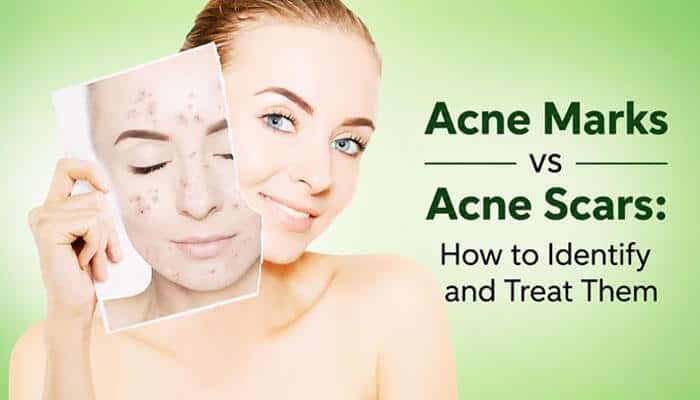

If you have ever looked in the mirror after a breakout and noticed dark spots or dents left behind on your skin, you have probably asked yourself: “Is this an acne mark or an acne scar?” Most people use these two terms interchangeably, but they are actually very different things. Understanding the difference between acne marks vs acne scars is the very first step toward getting the right treatment and finally getting clear, even skin.
Here is the honest truth: treating an acne mark the same way you treat an acne scar or vice versa is one of the biggest mistakes people make in their skincare routine. Some marks fade away on their own within a few weeks. Scars, on the other hand, can stick around for years or even become permanent if you do not address them properly. Knowing which one you are dealing with can literally save you months of frustration and hundreds of dollars spent on the wrong products.
In this complete guide, we are going to break down everything you need to know about acne marks vs acne scars, what causes them, how to tell them apart, and the most effective treatments available in 2026. Whether you are a teenager dealing with your first breakout or an adult who has been battling post-acne skin issues for years, this article will give you clear, simple, and science-backed answers.
What Are Acne Marks?
Acne marks (also called post-inflammatory hyperpigmentation or PIH) are flat discolorations left on the skin after a pimple heals. They are not actual damage to the skin’s structure; they are simply a change in skin color.
Think of it this way: when your skin gets inflamed from acne, it produces extra melanin (the pigment that gives your skin its color) as a defense response. When the pimple heals, that extra pigment can stay behind, leaving a dark, flat spot on your skin.
Key characteristics of acne marks:
- Flat, you cannot feel them when you run your finger over your skin
- Usually pink, red, brown, or dark brown in color
- No change in the skin’s texture
- Can fade on their own over weeks to months
- More common in people with medium to dark skin tones
- Caused by inflammation, not skin tissue damage
Acne marks are temporary. With the right skincare routine, most marks can fade significantly within 3–6 months, sometimes even faster.
What Are Acne Scars?
Acne scars are a different story altogether. When we talk about acne marks vs acne scars, the biggest difference is that scars involve actual physical damage to the skin tissue.
When severe acne (like cysts or nodules) damages the deeper layers of the skin, the body tries to repair itself by producing collagen. If too little collagen is produced, you get depressed (sunken) scars. If too much collagen is produced, you get raised scars. This is real structural damage, not just a color change.
Key characteristics of acne scars:
- Have a different texture than normal skin
- Can be depressed (pitted) or raised (bumpy)
- Do NOT fade on their own over time
- Often permanent without professional treatment
- Caused by damage to the deeper layers of skin (dermis)
- More likely to develop from severe, deep, or cystic acne
Unlike acne marks, scars are long-term. They require targeted treatments, often professional ones, to improve significantly.
Acne Marks vs Acne Scars: The Key Differences
This is the most important section of this article. Here is a simple, side-by-side comparison table so you can clearly understand the difference:
| Feature | Acne Marks | Acne Scars |
| Appearance | Flat, colored spots | Pitted, raised, or textured skin |
| Texture | Smooth, no texture change | Rough, you can feel the difference |
| Cause | Extra melanin production (inflammation) | Collagen damage in deep skin layers |
| Permanence | Temporary fades with time | Permanent without treatment |
| Timeline to fade | 3 weeks to 6 months | Months to years (requires treatment) |
| Skin layers affected | Epidermis (surface layer only) | Dermis (deep skin layer) |
| Common skin types | More visible in darker skin tones | Affects all skin types equally |
| DIY treatment | Often responds to OTC products | Usually needs professional treatment |
| Risk from popping pimples | Can worsen discoloration | Can create or worsen scars |
When comparing acne marks vs acne scars, marks are a surface-level issue, while scars are a deep-tissue issue. The treatment approach for each is completely different.
Types of Acne Marks
Not all acne marks look the same. There are two main types, and knowing which one you have helps you pick the right treatment.
1. Post-Inflammatory Hyperpigmentation (PIH)
- Appears as dark brown or black spots
- More common in people with medium to dark skin tones (Fitzpatrick skin types III–VI)
- Caused by overproduction of melanin
- Usually takes 3–6 months to fade
2. Post-Inflammatory Erythema (PIE)
- Appears as pink or red flat spots
- More common in people with lighter skin tones (Fitzpatrick skin types I–III)
- Caused by damaged or dilated blood vessels under the skin
- Usually takes 3–12 months to fade
Quick tip: If the spot is flat and you can not feel any texture difference, it is an acne mark, not a scar. The color (red vs dark brown) tells you what type of mark you are dealing with.
Types of Acne Scars
Acne scars come in multiple forms, and treatment approaches differ based on the type.
1. Atrophic Scars (Depressed/Sunken)
These are the most common type of acne scars. They form when the skin loses tissue during the healing process.
Three subtypes of atrophic scars:
- Ice Pick Scars: Deep, narrow, V-shaped pits. Look like tiny holes poked in the skin. Very difficult to treat.
- Boxcar Scars: Wider, U-shaped craters with sharp, defined edges. Can be shallow or deep.
- Rolling Scars: Broad, wave-like depressions that give the skin an uneven, rolling appearance. Caused by fibrous tissue pulling the skin downward.
2. Hypertrophic Scars (Raised)
These form when the body produces too much collagen during healing. They appear as firm, raised bumps on the skin. Most common on the chest, back, and shoulders.
3. Keloid Scars
Similar to hypertrophic scars, but grow beyond the original wound area. Keloids are more common in people with darker skin tones and can continue growing over time.
Causes of Acne Marks vs Acne Scars
What Causes Acne Marks?
- Inflammation: From any type of acne (whiteheads, blackheads, pustules)
- Sun exposure: UV rays make hyperpigmentation darker and harder to fade
- Popping or picking pimples: Causes more inflammation and more pigment
- Genetics: Some people are simply more prone to PIH
- Hormonal fluctuations: Common in women during periods or pregnancy
What Causes Acne Scars?
- Severe, deep acne: Cysts and nodules are the biggest culprits
- Delayed treatment: The longer acne stays inflamed, the deeper the damage
- Squeezing or picking: Forces bacteria and debris deeper, causing more damage
- Genetics: Some people are genetically prone to scarring
- Lack of proper skincare: Not using SPF, not treating active acne properly
Bottom line on causes: Both acne marks and acne scars can be made significantly worse by picking or popping pimples. This is the single most important habit to break if you want clearer skin.
How to Tell the Difference at Home
Here is a super simple test you can do right now to figure out if you have an acne mark or an acne scar:
The Touch Test
Run a clean finger gently over the spot:
- Completely smooth? → Acne mark (PIH or PIE)
- Feels like a dent, pit, bump, or uneven texture? → Acne scar
The Time Test
- Has the spot been there less than 6 months, and seems to be getting lighter? → Likely an acne mark
- Has the spot been there for over a year with little to no change? → Likely an acne scar
The Light Test
Shine a flashlight at a side angle across your skin:
- No shadows or raised/depressed areas, just color change? → Acne mark
- Visible shadows, pits, or raised bumps? → Acne scar
Summary checklist:
| Sign | Acne Mark | Acne Scar |
| Flat to the touch | Yes | No |
| Getting lighter over time | Yes | No (or very slowly) |
| Visible texture/depth | No | Yes |
| Present for 1+ years unchanged | Unlikely | Possible |
Treatments for Acne Marks
The good news: most acne marks respond really well to at-home treatments. Here is what actually works.
Over-the-Counter (OTC) Ingredients
1. For PIH (dark/brown marks):
- Niacinamide (Vitamin B3): One of the best ingredients for fading dark spots. Reduces melanin transfer to the skin surface. Use 5–10% concentration.
- Vitamin C (L-Ascorbic Acid): Brightens skin and inhibits melanin production. Most effective at 10–20% concentration.
- Alpha Arbutin: Gentle brightening agent. Safe for all skin tones, including dark skin.
- Kojic Acid: Derived from fungi, blocks an enzyme needed for melanin production.
- Azelaic Acid: Great for both PIH and acne. Anti-inflammatory and brightening. Works well at 10–20%.
- Tranexamic Acid: Newer ingredient that works brilliantly for stubborn dark spots.
2. For PIE (red/pink marks):
- Niacinamide: Also helps reduce redness and strengthen the skin barrier.
- Centella Asiatica (Cica): Calms inflammation and supports blood vessel health.
- Green Tea Extract: Antioxidant-rich, helps reduce redness.
- Azelaic Acid: Works well for redness, too.
Do not forget SPF:
- Sunscreen is the most important product for treating acne marks. UV exposure makes dark spots significantly darker. Use SPF 30–50 every single morning, even on cloudy days.
3. Chemical Exfoliants
- AHA (Glycolic Acid, Lactic Acid): Speed up cell turnover to bring fresh, even-toned skin to the surface. Great for marks.
- BHA (Salicylic Acid): Works inside pores, reduces active breakouts, and helps fade marks.
Professional Treatments for Acne Marks
If OTC products are not enough:
- Chemical Peels: Glycolic or lactic acid peels done by a professional give faster results.
- IPL (Intense Pulsed Light): Especially good for red/pink marks (PIE).
- Laser treatments: Low-level laser therapy can help with stubborn hyperpigmentation.
Treatments for Acne Scars
Treating acne scars vs acne marks requires a very different approach. Because scars involve structural skin damage, most require professional intervention for significant improvement.
Professional Treatments for Acne Scars
1. For Atrophic (Depressed) Scars:
- Microneedling (Collagen Induction Therapy): Uses tiny needles to trigger collagen production and fill in depressed scars. One of the most popular and effective treatments. Multiple sessions required.
- Chemical Peels (Medium to Deep): TCA (trichloroacetic acid) peels can significantly improve rolling and boxcar scars.
- Fractional Laser Resurfacing: CO2 or Erbium lasers precisely remove top layers of skin to stimulate new collagen. Highly effective for boxcar and rolling scars.
- Subcision: A needle is inserted under the scar to break up fibrous tissue that pulls the skin down. Often combined with other treatments.
- Dermal Fillers: Hyaluronic acid or other fillers injected under deep scars to temporarily lift them. Results last 6–18 months.
- Punch Excision: Surgical removal of individual ice pick scars. Very effective for deep, narrow scars.
2. For Hypertrophic and Keloid Scars:
- Steroid Injections (Corticosteroids): Flatten and soften raised scars. Often, the first line of treatment.
- Silicone Sheets/Gels: Applied to raised scars over time to flatten them.
- Laser Therapy: Vascular lasers reduce redness; fractional lasers improve texture.
- Cryotherapy: Freezing the scar tissue to flatten it.
At-Home Supportive Care for Scars
While professional treatments are usually necessary, these ingredients can support the healing process:
- Retinoids (Retinol, Tretinoin): Stimulate collagen production and speed up cell turnover. Prescription tretinoin is the gold standard.
- Peptides: Support collagen and elastin synthesis.
- SPF (Always): Prevents scars from darkening and worsening.
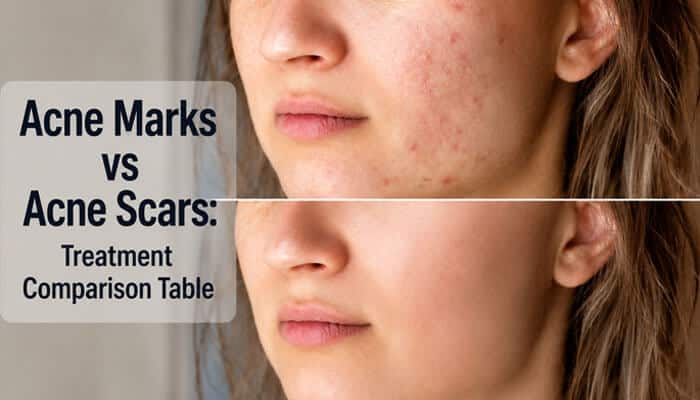
Acne Marks vs Acne Scars: Treatment Comparison Table
| Treatment | Works for Acne Marks | Works for Acne Scars | Professional Needed? | Average Cost (USD) |
| Sunscreen (SPF 30–50) | Essential | Supporting | No | $10–$40 |
| Niacinamide | Yes | Limited | No | $10–$30 |
| Vitamin C Serum | Yes | Limited | No | $15–$80 |
| Azelaic Acid | Yes | Limited | No | $15–$50 |
| Retinoids/Tretinoin | Yes | Mild improvement | Rx needed | $20–$100 |
| Chemical Peel (light) | Yes | Mild | Yes | $100–$300 |
| Microneedling | Yes | Excellent | Yes | $200–$700/session |
| Fractional Laser | Yes | Excellent | Yes | $500–$2,500 |
| Subcision | Not needed | Very good | Yes | $300–$800 |
| Dermal Fillers | Not needed | Temporary | Yes | $500–$1,500 |
| Steroid Injections | Not needed | Raised scars | Yes | $50–$200 |
| IPL Therapy | Great for PIE | Some | Yes | $300–$600 |
Note: Costs are approximate and vary by location, provider, and number of sessions needed.
Prevention Tips
Preventing acne marks and acne scars before they form is always easier than treating them afterward. Here is what you can do starting today:
To prevent acne marks:
- Wear sunscreen every single day (this is non-negotiable)
- Treat active acne early and consistently
- Avoid picking, popping, or squeezing pimples
- Use anti-inflammatory skincare (niacinamide, azelaic acid)
- Stay consistent with your skincare routine
To prevent acne scars:
- Treat severe acne (cysts, nodules) with a dermatologist’s help do not delay
- Never squeeze deep, painful cysts
- Use prescription medications (retinoids, benzoyl peroxide) to reduce inflammation
- Keep the skin barrier healthy with moisturizer and SPF
- Avoid harsh, abrasive scrubs that can worsen inflammation
General good habits:
- Do not sleep with makeup on
- Use non-comedogenic (non-pore-clogging) products
- Drink plenty of water and eat a balanced diet
- Manage stress (stress hormones can trigger breakouts)
- Change pillowcases at least twice a week
When to See a Dermatologist
You should schedule an appointment with a board-certified dermatologist if:
- You have active cystic or nodular acne (this is the leading cause of permanent scarring)
- Your acne marks have not improved after 6 months of consistent OTC treatment
- You have visible pitting, raised bumps, or texture changes (these are scars that need professional care)
- Your skin concerns are affecting your confidence or mental health
- You are unsure whether you have marks or scars
- You want personalized guidance on the best treatment for your skin tone
A dermatologist can prescribe stronger treatments like tretinoin, hydroquinone (in some countries), or referral for laser and microneedling procedures. Getting professional help early, especially for active severe acne, can prevent permanent scarring from forming in the first place.
Summary: Everything You Need to Remember
Here is a quick recap of the key differences between acne marks vs acne scars:
- Acne marks are flat discolorations (red, pink, brown, or dark) caused by post-inflammatory pigment changes. They are temporary and can be treated with OTC products and sunscreen.
- Acne scars are structural changes to the skin pits, dents, or raised bumps, caused by collagen damage in deep skin layers. They are generally permanent without professional treatment.
- The touch test is the easiest way to tell the difference: if it is flat and smooth, it is a mark; if it has texture, it is a scar.
- Prevention is everything. Wearing sunscreen, treating active acne early, and never picking at pimples are the three most powerful things you can do for your skin.
- If you are unsure or have visible textural damage, see a dermatologist. Early intervention gives you the best results.
Understanding the difference between acne marks vs acne scars is not just about terminology; it is about giving yourself the right treatment, saving money on ineffective products, and finally seeing real results in your skin.
Acne Marks vs Acne Scars FAQs
1. What is the main difference between acne marks vs acne scars?
The main difference between acne marks vs acne scars is texture. Acne marks are flat spots caused by color changes after acne heals, while acne scars are dents, pits, or raised areas caused by deeper skin damage.
2. How can I tell if I have acne marks or acne scars?
You can do a simple touch test. If the spot feels smooth and flat, it is likely an acne mark. If it feels like a dent, hole, bump, or uneven texture, it is likely an acne scar.
3. Do acne marks go away on their own?
Yes, acne marks often fade over time. Depending on your skin type, routine, and sun protection, acne marks may fade within a few weeks to several months.
4. Which is easier to treat: acne marks or acne scars?
When comparing acne marks vs acne scars, acne marks are easier to treat. They often respond well to sunscreen, niacinamide, vitamin C, azelaic acid, and gentle exfoliation. Acne scars usually need professional treatment.
5. Can sunscreen help with acne marks and acne scars?
Yes. Sunscreen is essential for both acne marks and acne scars. It prevents dark spots from becoming darker and helps protect healing skin from further damage.
6. When should I see a dermatologist for Acne Marks vs Acne Scars?
You should see a dermatologist if your acne marks do not improve after 6 months, if you have pitted or raised scars, or if you have painful cystic acne. A dermatologist can identify whether you are dealing with acne marks or acne scars and suggest the right treatment.
7. Why is understanding Acne Marks vs Acne Scars important?
Understanding acne marks vs acne scars is important because each condition needs a different treatment. Using the wrong products can waste time, delay results, and make skin concerns worse.
8. How long does it take to treat acne marks?
Acne marks may improve within 3 weeks to 6 months with consistent skincare, sunscreen, and brightening ingredients. Deeper or darker marks may take longer.
