
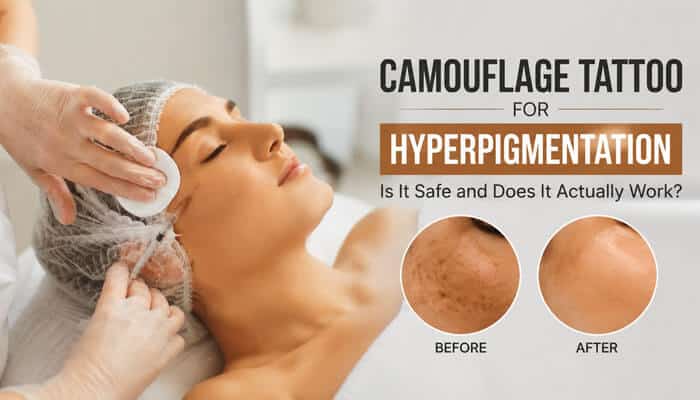

Dark spots, uneven patches, and stubborn discoloration on the skin can feel really frustrating, especially when nothing seems to fully cover or fix them. If you’ve tried creams, serums, and treatments without much luck, you might have come across something called a camouflage tattoo for hyperpigmentation. It sounds like a bold solution, and honestly, for many people, it has been a life-changing one.
A camouflage tattoo is not your regular decorative tattoo. It is a special cosmetic procedure where skin-toned pigment is tattooed directly into the skin to match the surrounding areas and hide discoloration. Think of it like color-correcting makeup but permanent, and under the skin. Dermatologists and trained tattoo artists use this technique to help people who feel self-conscious about patches of darker skin that don’t respond well to regular treatments.
This article will walk you through everything you need to know about getting a camouflage tattoo for hyperpigmentation, from how the procedure actually works to who should (and should not) consider it, what the risks are, how much it costs, and what real results look like. Whether you are a teenager curious about your skin or an adult who has been dealing with this for years, this guide will give you clear, no-nonsense information to help you make the right decision.
What Is Hyperpigmentation and Why Is It So Hard to Treat?
Before diving into camouflage tattoos, it helps to understand what hyperpigmentation actually is.
Hyperpigmentation happens when certain areas of your skin produce too much melanin, the pigment that gives your skin its color. This creates patches or spots that are darker than the rest of your skin. It is extremely common and can affect people of all skin tones.
Common types of hyperpigmentation include:
- Post-inflammatory hyperpigmentation (PIH): Dark spots left behind after acne, cuts, burns, or insect bites
- Melasma: Brown or gray-brown patches, often triggered by hormones or sun exposure
- Sun spots (solar lentigines): Flat brown spots caused by years of UV exposure
- Birthmarks: Areas of darker or differently colored skin present since birth
- Scarring-related discoloration: Marks left after surgery or injury
Most treatments like vitamin C serums, retinoids, chemical peels, and laser therapy work by reducing melanin production or removing damaged skin layers. These work well for mild cases, but for deeper or more stubborn discoloration, results are often slow, inconsistent, or incomplete. That is where a camouflage tattoo for hyperpigmentation steps in as an alternative option.
What Exactly Is a Camouflage Tattoo for Hyperpigmentation?
A camouflage tattoo for hyperpigmentation, also called skin-tone tattooing, corrective pigmentation, or medical tattooing, is a cosmetic procedure that uses tattoo ink to deposit skin-matching pigments into the upper layer of the skin (called the dermis). The goal is to visually blend the darker or discolored area with the surrounding skin.
This is different from regular body tattoos in a few important ways:
| Feature | Regular Tattoo | Camouflage Tattoo for Hyperpigmentation |
| Purpose | Decoration / art | Correcting skin tone / covering discoloration |
| Ink color | Any color | Skin-tone matched pigments only |
| Depth of needle | Deeper dermis | Superficial to mid-dermis |
| Who performs it | Tattoo artist | Trained cosmetic/medical tattoo artist |
| Result visibility | Bold, visible design | Blends with natural skin |
| Permanence | Permanent (can fade) | Long-lasting but may need touch-ups |
The procedure is also sometimes referred to as micropigmentation or paramedical tattooing when done in a clinical or medical setting.
How Does the Procedure Work? Step by Step
Understanding the process helps remove fear and set realistic expectations.
Step 1: Skin Tone Color Matching
The most critical part of a camouflage tattoo for hyperpigmentation is getting the color right. A skilled technician will mix pigments to match your exact skin tone. This is an art and a science. Your skin tone can vary depending on lighting, sun exposure, and even the season.
Step 2: Patch Test
Before the full procedure, a small test area is done to see how your skin reacts to the pigment and to confirm the color match is accurate.
Step 3: Skin Preparation
The area to be treated is cleaned, and a numbing cream is applied to reduce discomfort during the process.
Step 4: Pigment Application
Using a tattoo machine or a specialized pen device, the technician deposits pigment into the skin using fine needles. Multiple passes may be needed to build up the color evenly.
Step 5: Healing and Follow-Up
The treated area goes through a healing period of around 4 to 6 weeks. During this time, the color will look darker at first and then settle into the intended shade. A follow-up appointment checks the results and adds touch-ups if needed.
Who Is a Good Candidate for a Camouflage Tattoo?
Not everyone is an ideal fit for this procedure. A camouflage tattoo for hyperpigmentation tends to work best for people who meet specific conditions.
You may be a good candidate if:
- Your hyperpigmentation is stable (not actively spreading or changing)
- You have post-inflammatory marks from acne, burns, or scars
- You have birthmarks or port-wine stains
- You have had surgery and are left with visible discoloration
- Traditional treatments have not worked for you
- Your skin tone is relatively consistent in the area around the discoloration
You may NOT be a good candidate if:
- You have active acne or skin infections in the target area
- You are pregnant or breastfeeding
- You have a history of keloid scarring
- You have very dynamic skin tone (like melasma, which changes with hormones and sun)
- You are on blood thinners or immunosuppressants
- You have very dark skin where tonal matching is more complex (it can still be done, but requires extra expertise)
Consulting a board-certified dermatologist or a certified paramedical tattoo artist before booking is absolutely important. This is not a one-size-fits-all procedure.
Does Camouflage Tattoo for Hyperpigmentation Actually Work?
This is the big question. The short answer is yes, it can work, but with important conditions.
Results vary based on:
- Skill of the technician: This is probably the single most important factor. An experienced artist who specializes in skin-tone tattooing will have a much better color-matching ability.
- Type of hyperpigmentation: PIH and scar discoloration tend to respond best. Melasma is trickier because it is driven by hormones and can change over time.
- Your skin tone: Light to medium skin tones are generally easier to match. Deeper skin tones require a technician experienced with dark complexions.
- Sun exposure after treatment: Ultraviolet rays can darken the surrounding skin but not the tattoo pigment, which may cause the camouflage to look off over time.
Realistic expectations to keep in mind:
- Results are rarely 100% perfect. The goal is a significant reduction in visible discoloration, not invisibility
- Touch-up sessions (every 1–3 years) are often needed as pigment fades
- Camouflage tattoos are most effective in areas that are not frequently exposed to intense sun
Is It Safe? Understanding the Risks
Safety is the most critical thing to consider before any cosmetic procedure. A camouflage tattoo for hyperpigmentation is generally considered safe when performed by a qualified professional, but risks do exist.
Potential risks include:
- Allergic reactions: Some people react to tattoo pigments, especially those with metalite-based dyes
- Infection: Any skin puncture carries an infection risk if hygiene is not maintained
- Color mismatch: If the color shifts or your surrounding skin changes tone, the treated area can look unnatural
- Granulomas: Small bumps that can form around tattoo pigment particles
- Keloid formation: People prone to raised scars should be especially cautious
- MRI interference: Certain iron oxide-based pigments can cause reactions during MRI scans (though rare)
- Hyperpigmentation worsening: In rare cases, trauma from the needle can worsen discoloration, especially in deeper skin tones
Key safety tips:
- Always choose a licensed professional with verifiable training in paramedical or cosmetic tattooing
- Ask to see a portfolio of their work, especially on skin tones similar to yours
- Make sure they perform a patch test before the full treatment
- The studio or clinic should follow medical-grade hygiene and use sterile equipment
- Get clear written information about what pigments will be used
Camouflage Tattoo vs. Other Hyperpigmentation Treatments
How does this procedure compare to other popular options?
| Treatment | How It Works | Best For | Average Cost | Permanence |
| Camouflage tattoo | Deposits skin-tone pigment | PIH, scars, birthmarks | $300–$1,500+ | Long-lasting, needs touch-ups |
| Laser therapy | Breaks up melanin | Sun spots, PIH, melasma | $200–$1,000/session | Semi-permanent |
| Chemical peel | Removes top skin layers | Mild PIH, sun damage | $150–$600/session | Temporary |
| Topical creams | Reduces melanin production | Mild discoloration | $20–$200/month | Temporary |
| Microneedling | Stimulates skin renewal | PIH, scars | $200–$700/session | Semi-permanent |
| Dermabrasion | Physically removes the top layer | Scars, uneven texture | $500–$4,000 | Semi-permanent |
The main advantage of a camouflage tattoo for hyperpigmentation is that it does not try to change the skin; it adds color on top of the discoloration. This makes it useful even when other treatments have failed. However, it requires more commitment than a cream and more skill than a laser session.
How Much Does a Camouflage Tattoo for Hyperpigmentation Cost?

Pricing varies widely depending on several factors:
- Size of the area being treated (small spot vs. large patch)
- Location of the clinic or studio (urban areas tend to be pricier)
- Experience level of the technician
- Number of sessions required (some cases need 2–4 appointments)
- Country prices in the US, UK, and Australia are typically higher than in South Asia or Southeast Asia
Rough cost estimates (per session):
- Small spot (coin-sized): $150 to $400
- Medium patch (palm-sized): $400 to $900
- Large area (limb or torso section): $900 to $2,000+
Most clients need at least 2 sessions. Follow-up touch-ups every 1–3 years add to the long-term cost. Unfortunately, most health insurance plans do not cover this procedure as it is considered cosmetic unless it is part of post-surgical reconstruction, in which case coverage may apply.
Caring for Your Skin After a Camouflage Tattoo
Aftercare plays a huge role in how well your results hold up. Ignoring aftercare can ruin an otherwise perfect outcome.
During the first 2 weeks:
- Keep the area clean and moisturized with a gentle, fragrance-free lotion
- Do not pick, scratch, or rub the treated skin
- Avoid direct sun exposure and always wear SPF 50+ if going outside
- Skip swimming, saunas, or intense sweating activities
- Do not apply any active skincare ingredients (AHAs, BHAs, retinol) to the area
Long-term care:
- Use sunscreen every single day. This is the most important step to preserving your results
- Avoid tanning beds entirely
- Be consistent with skin hydration
- Schedule annual check-ins with your tattoo artist to assess if a touch-up is needed
Finding the Right Professional
Choosing the right technician is honestly more important than any other decision in this process. Here’s what to look for:
Credentials to check:
- Training in paramedical tattooing or micropigmentation
- Certification from a recognized cosmetic tattoo school or program
- Experience specifically with skin-tone correction and hyperpigmentation cases
- A solid portfolio showing real before-and-after results (not just heavily edited photos)
Questions to ask during consultation:
- How many hyperpigmentation cases have you treated on skin tones like mine?
- What pigments do you use and are they FDA-approved or equivalent?
- Do you perform patch tests before every procedure?
- What is your process if the color does not match correctly after healing?
- What aftercare products do you recommend?
Red flags to watch out for include vague answers, refusal to show a real portfolio, skipping a patch test, or offering unusually cheap prices. With cosmetic tattooing, you really do get what you pay for.
What Real People Say About Results
People who have had a camouflage tattoo for hyperpigmentation often describe the experience as emotionally powerful, not just cosmetically helpful. For those who have dealt with visible skin discoloration for years, regaining a more even skin appearance can boost confidence significantly.
Common themes in real experiences include:
- Relief from not needing heavy makeup or concealer every day
- Increased confidence in social situations and professional settings
- Surprise at how natural the results look in good lighting
- Some frustration with slight color shifts in different lighting conditions
- Satisfaction with the overall outcome, especially when managed expectations were in place
Results are not always perfect, and some people need more sessions than anticipated. But the majority who choose a skilled, experienced practitioner report being genuinely happy with the outcome.
Final Thoughts
A camouflage tattoo for hyperpigmentation is not a miracle cure, but it is a genuinely effective option for many people who have struggled with visible skin discoloration. When performed by a skilled, certified professional with proper color matching and aftercare, it can significantly reduce the appearance of dark patches and improve skin confidence.
The procedure works best for stable, post-inflammatory, or scar-related discoloration on people who have realistic expectations and are willing to take good care of their skin afterward. It is not ideal for melasma or actively changing pigmentation, and it does require ongoing sun protection to maintain results.
If you are seriously considering this option, start with a dermatologist consultation to rule out any underlying skin conditions. Then, research certified paramedical tattoo artists in your area who have proven experience with skin-tone correction. Look at their portfolios, ask detailed questions, and take your time. A little research up front can make a huge difference in how happy you are with your results.
Your skin is worth the care, and with the right professional by your side, a camouflage tattoo for hyperpigmentation might just be the solution you’ve been looking for.
Camouflage Tattoo for Hyperpigmentation FAQ’s
1. Is a camouflage tattoo for hyperpigmentation permanent?
It is long-lasting but not truly permanent. The pigment will gradually fade over several years, especially with sun exposure. Most people schedule touch-ups every 1 to 3 years to maintain results.
2. Does the procedure hurt?
A numbing cream is applied beforehand, so discomfort is minimal for most people. Sensitive skin areas may feel more tender during the process.
3. Can it be done on any skin tone?
Yes, but skill requirements are higher for darker skin tones. It is extremely important to choose a technician experienced with your specific complexion.
4. What happens if the color does not match?
A good technician will factor in a healing period before finalizing the match. Minor adjustments can be made in follow-up sessions. Always insist on a patch test to reduce this risk.
5. Is it safe during pregnancy?
No. It is not recommended during pregnancy or breastfeeding due to hormonal skin changes and safety concerns with pigment absorption.
6. Will it interfere with MRI scans?
Certain pigments with iron oxide can heat up or cause reactions during MRI. Always inform your doctor and MRI technician about any cosmetic tattoo you have.
